At yesterday’s House Appropriations budget hearing, State Representative Emily Kinkead (D-PA-20, Allegheny County) asked Pennsylvania State Police Acting Commissioner Lt. Colonel George Bivens a direct question: why hasn’t PSP implemented the telephonic registration system that the General Assembly required — by law — back in 2018?
She didn’t get a direct answer.
We wish we could say we were surprised.
What You’re Watching
The clip circulating from Tuesday’s hearing captures something PARSOL has been experiencing firsthand for more than a year: the Pennsylvania State Police responding to a straightforward question about a statutory mandate with deflection, bureaucratic hedging, and no clear accounting for eight years of non-implementation.
Rep. Kinkead deserves credit for putting this question on the public record. The Appropriations Committee hearing is exactly where it belongs. When an agency comes before the legislature to request taxpayer funding — for new programs, new priorities, expanded capacity — the threshold question has to be: are you executing the responsibilities you already have?
Based on everything PARSOL has documented, the answer with respect to the telephonic registration system is no.
A Quick Recap of What the Law Requires
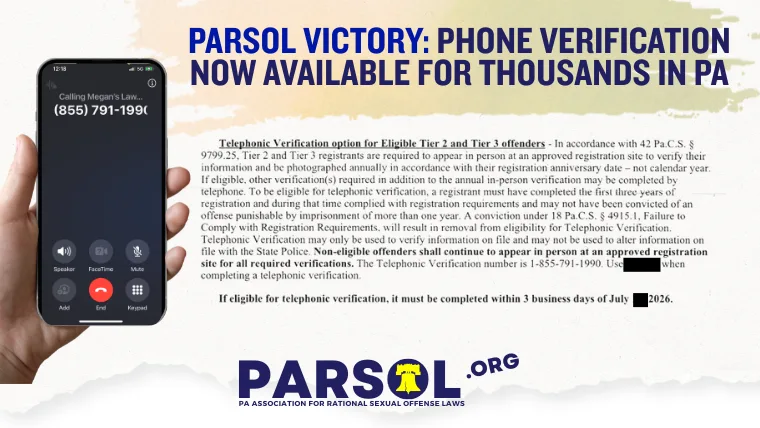
Act 10 of 2018 amended Pennsylvania’s Megan’s Law to give individuals who had maintained full registration compliance for three consecutive years the option to complete most of their quarterly check-ins by telephone rather than appearing in person. The Pennsylvania State Police were required to build and operate that system, and were prohibited from opening it to registrants until they published a formal notice in the Pennsylvania Bulletin confirming it was operational.
That notice ran on June 3, 2023 — five years after the law was enacted.
What has happened since is what PARSOL spent the past fourteen months trying to find out.
What We Found
The short version: a system that PSP declared operational has been administered so inconsistently that its own staff didn’t know how to use it, didn’t have procedures for it, and — as recently as January 2026 — denied its existence entirely to a PARSOL member trying to register at a state police barracks.
The longer version is in our policy memorandum, which we transmitted to House and Senate leadership this week ahead of the budget hearings. Here are the lowlights:
When PARSOL first contacted the PSP’s Megan’s Law Division in January 2025 — nearly seven years after the law’s enactment — a corporal’s response was that PSP was “aware of the statute.” When we pushed for implementation details, we were told to file a Right-to-Know request. That request was eventually rejected as outside the scope of the Right-to-Know Law.
In April 2025, PARSOL staff called the designated telephonic registration phone number. The person who answered said they were unable to process telephonic registrations because they hadn’t received procedures for how to do so — more than two years after PSP’s own Pennsylvania Bulletin announcement declared the system open.
By November 2025, a PARSOL member was turned away from telephone registration with no explanation. When our staff called the number, it rang without answer for over two minutes.
In January 2026, a PARSOL member attempting to register by phone was told that PSP was manually reviewing every registrant and that the process would take years. That same member then went to register in person and asked about the telephone option. The troopers told him it didn’t exist.
Why This Is About More Than a Phone System
Pennsylvania spends millions of dollars every year maintaining, staffing, and enforcing the sex offense registry. Law enforcement hours go toward address verification checks, compliance monitoring, and registry administration — resources that could be directed toward investigating new offenses, clearing rape kit backlogs, or funding prevention programs that research consistently shows are far more effective at stopping harm before it occurs.
What does the public get in return? After decades of expansive registry laws, there is no credible evidence that public registries reduce rates of sexual violence. States with the most stringent registry requirements don’t see meaningfully lower rates of sexual offenses than states with more moderate approaches. Ninety-five percent of sexual offenses are committed by individuals with no prior conviction — people who wouldn’t appear on any registry regardless of how comprehensive it was.
We are not arguing that accountability doesn’t matter. It does. People who commit sexual offenses must be held responsible — and they are, through prosecution, incarceration, supervised release, and mandated treatment. But after accountability comes a legitimate public policy question: are we spending public dollars on approaches that actually prevent future harm, or on systems that have become an enormous, expensive apparatus that studies consistently show fails to deliver the safety returns it promises?
The telephonic registration system is one small but telling example of that larger dysfunction. The legislature passed a law that could ease an unnecessary burden on low-risk individuals who have demonstrated years of compliance, while freeing PSP to focus on those who actually require intensive supervision. Eight years later, the system still doesn’t reliably work. And when a legislator asks why, the answer is a non-answer.
What We’re Asking
PARSOL is calling on the General Assembly to hold PSP accountable before approving new program funding. Specifically:
Demand answers about the current operational status of the telephonic registration system — not talking points, but documentation of who can use it, how they access it, what the procedures are, and how PSP ensures consistent administration across all its stations.
Require updated notices. The law requires PSP to include the telephonic registration phone number in every advance notice sent to eligible registrants. To our knowledge, this is not consistently happening. That needs to change.
Ask the hard fiscal question. The registry costs Pennsylvania taxpayers millions annually. If any other government program consumed this level of resources without demonstrable public safety returns, the Appropriations Committee would demand a cost-benefit accounting. The registry deserves the same scrutiny.
Watch the Full Question & Response
We’re grateful to Rep. Kinkead for putting this on the record. We hope it’s the beginning of a longer conversation in Harrisburg about whether Pennsylvania’s approach to the sex offense registry — as currently structured and administered — is actually making anyone safer, or simply consuming enormous public resources while failing the very statutory requirements the legislature has already set.
The memo we sent to legislative leadership this week documents the full picture. You can read it here: [Download the PARSOL Policy Memorandum →]
PARSOL is the Pennsylvania Association for Rational Sexual Offense Laws, a NARSOL state affiliate. We advocate for evidence-based, constitutionally sound public safety policy in Pennsylvania. Learn more or get involved at parsol.org.